


_2025-nada-ceramics-2026-18.jpg)





.png)
Wassaic Project at NADA Ceramics 2026
Cost
Where
The Locker Room
253 Church St
New York, NY
When
Opening
Friday, March 6, 2026
4–8 PM
Hours
Saturday, March 7, 2026
12–8 PM
Sunday, March 8, 2026
12–6 PM
Who
We're proud to be participating in NADA Ceramics 2026, showcasing diverse ceramic art and design work from Eve Biddle (Wassaic Project Co-Executive Director), Grace Hager (Wassaic Project Residency and Exhibition Artist Alumna), Lauren Cohen (Wassaic Project Exhibition Artist Alumna), and Madeline Donahue (Wassaic Project Residency and Exhibition Artist Alumna). Curator, author, and historian Glenn Adamson will be writing a short essay to accompany the presentation.
Will Hutnick, Wassaic Project’s Director of Artistic Programming, states, “Wassaic Project is thrilled to be bringing these four women artists together for the first time. They are all working at the intersection of media and pushing the boundaries of what ceramics can be today.”
· · ·
About the Artists
Eve Biddle is an artist, culture maker, and collaborator. Her work lies at the intersection of making objects, making connections between people, curating, building projects and institutions, helping to bring other artists’ art into the world, and making and facilitating public art. She’s a founding co-director of the Wassaic Project, home to a year-round artist residency program, art exhibitions, music festivals, and art education programs for kids, teens, and adults. Recent exhibitions include The Williams College Museum of Art in Williamstown, MA, Davidson Gallery and Sargent’s Daughters in New York City, The Buffalo Institute for Contemporary Art in Buffalo, NY, The Museum of Art and Design, New York City and Geary Gallery, Millerton, NY. Biddle has an upcoming solo exhibition at the Portland Museum of Art in Maine in 2026.
Grace Hager is an interdisciplinary painter and ceramic sculptor. Her work locates the natural world as a realm of possibility: a source of transformative encounters that generate awe, revealing the magical within the observable world. She received her Master of Fine Arts in 2023 and Bachelor of Fine Arts in Painting with a Minor in Art History in 2015 both from Maine College of Art & Design. Grace has exhibited throughout the United States, including at the Center for Maine Contemporary Art, Caldbeck Gallery, Institute of Contemporary Art, Portland, ME, Wassaic Project, MEPAINTSME, OVERLAP Gallery, CT State Gateway Community College, The Parsonage, and George Marshall Store Gallery, among others. She is the recipient of multiple grants and awards, including a CERF+ Get Ready Grant, a MAC Springboard Grant, a partial James Bernard Haggarty Scholarship, a grant from the Belvedere Fund, and a project grant from the Puffin Foundation. She is the recipient of a Fellowship in Painting from Vermont Studio Center and has been an artist-in-residence at Cuttyhunk Island Artist Residency, Wassaic Project, and Maine College of Art & Design, among others. She is a part of the 2025 Canopy Cohort under the mentorship of Rose Nestler. She currently lives and works in Southern Maine. Alongside her own work in the studio, Grace assists her former faculty and mentor, Gail Spaien, in her studio.
Lauren Cohen is an interdisciplinary artist working across drawing, painting, ceramics, film, and installation. Her practice develops recurring characters and constructed narrative worlds that examine psychological, relational, and cultural systems. Beginning with drawing and storytelling, Cohen generates figures that move between interior states and shared archetypes. These narratives extend into paintings and ceramic works, where emotional and symbolic structures are translated into material form. Across media, her work considers how identity, memory, desire, intimacy, and power are shaped, rehearsed, and sustained. In the exhibition space, Cohen brings these elements together through installation. Paintings, objects, and moving images are arranged as immersive environments that privilege accumulation and resonance over fixed interpretation. While rooted in introspection, the work resists direct autobiography, offering open narrative structures that invite multiple points of entry and collective reading.
Madeline Donahue lives and works in Brooklyn, NY. Her ceramic work was recently acquired by the Museum of Fine Arts, Boston. Residencies include The Wassaic Project, Byrdcliffe Artist Colony, Artshack Ceramic Residency and more recently, Interlude Artist’s Residency in Livingston, NY; a residency designed for artist families. Solo Exhibitions include “Fun House” with Praise Shadows Gallery, Boston; “Warm Up” with Artshack Brooklyn, and “Attachments” with Steven Harvey Fine Art Projects in New York. Along with Johansson Projects’ (Oakland, CA) summer group show, Community Garden, she has exhibited extensively across the US and in London. Her work is reviewed and she is interviewed in the Guardian, Hyperallergic, and Elephant Magazine, Sound + Vision Podcast, I Like Your Work Podcast, Artist Mother Podcast and more.
"All Together Now"
a short essay by Glenn Adamson
Ceramic is the original social technology. No sooner was clay formed and fired than it started serving as a focal point for gathering. That is a role it has had ever since. The typologies have varied greatly – archaic cooking vessel, wine-filled amphora, Renaissance charger, 12-person dinner service, 24-hour diner mugs – but wherever people come together, ceramics are almost always present. Partly, of course, this is because of their practicality. Pottery is relatively cheap, durable, mass producible, and easily decorated. Yet it’s arguably on the level of metaphor that it does its real cultural work. What could be more reassuring than a material that was once malleable, wet, and clammy, and is now fixed, warm, and dry? Not for nothing do we speak of “clay bodies,” around which we arrange our own.
Though it was founded only in 2008, Wassaic Project taps into these ancient energies. The vibrant residency and exhibition program, set in former agricultural buildings in Duchess County, draws musicians, writers, and visual artists working across all media. Ceramics has a special place, partly because there is a dedicated studio for the medium (a somewhat unusual provision, among residency centers), and partly because so many members of the community share a passion for clay. This presentation at NADA features Wassaic co-founder Eve Biddle, as well as Lauren Cohen, Madeline Donahue, and Grace Hager, all alumnae of the program.
A work from Hager’s series Sunset Seeking has become an unofficial emblem of the exhibition at NADA Ceramics. Entitled Starry Night, it refers to Vincent Van Gogh not just in its title but its celestial color palette and restless directional brushstrokes. It’s also, as Hager puts it, a “sort of wink at the role of temperature and heatwork required for the craft.” (This might just be the oldest joke in ceramics, given that the Jōmon people of ancient Japan made “flame-topped” pots about 5,000 years ago.) Most importantly, the sculpture evokes the experience of nighttime communion, of huddling together for warmth in the darkness. Much of Hager’s work, whether in painting or ceramic, focuses on such moments of magical connection – a metaphorical interest that the other artists in this presentation also share. They have forged strong connection to one another through the community at Wassaic Project, at a time when the very idea of community has been subjected to unprecedented stress, both due to the Covid pandemic and the reactionary, divisive politics that were accelerated by that period of mass isolation.
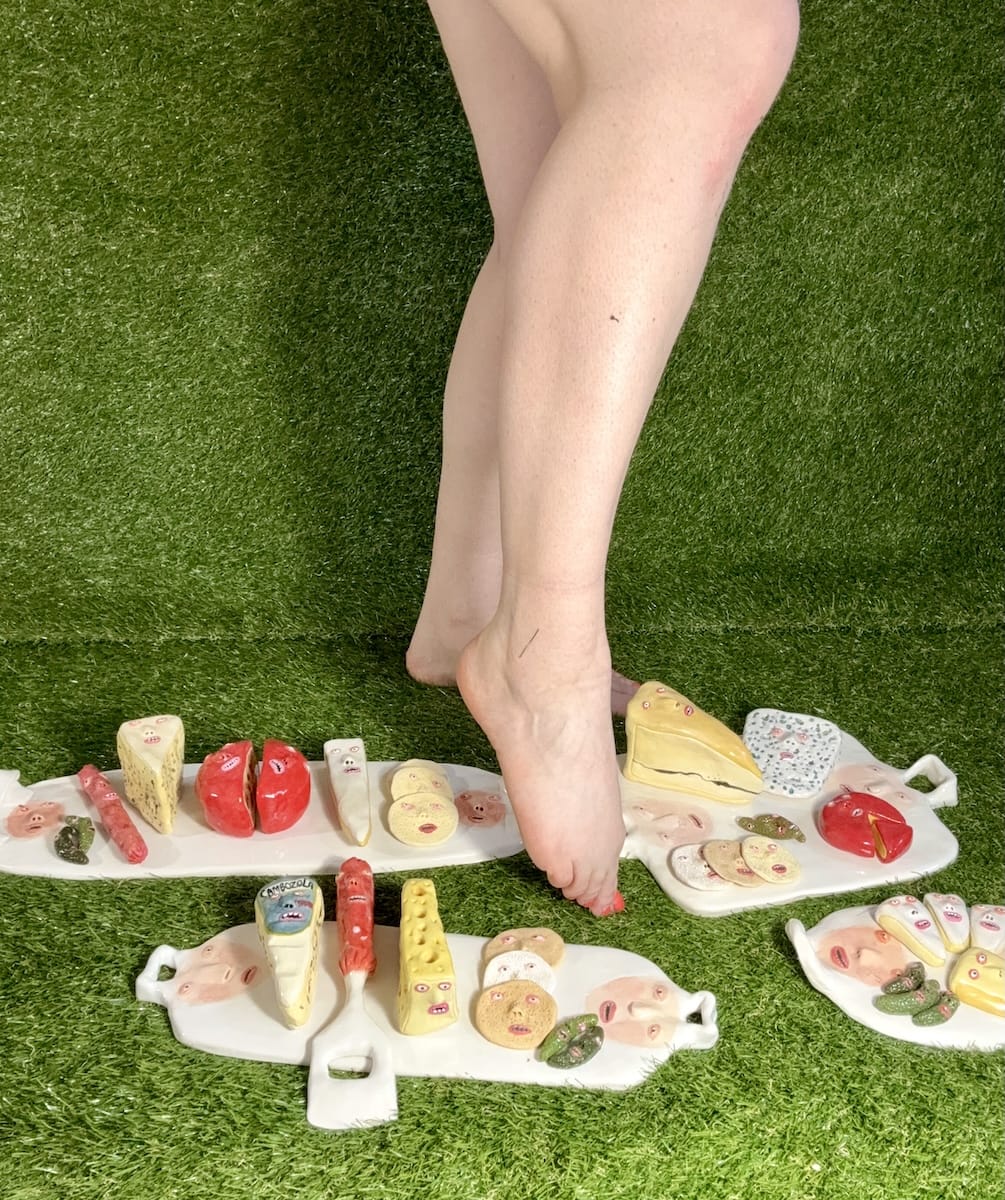
In response to this unfolding tragedy of the commons, this quartet of artists offer both alert critique and “full-on play” (as Biddle puts it), a combination of activism and absurdism. Lauren Cohen exemplifies this approach. Her wide-ranging practice encompasses not just ceramic sculpture but also painting, graphic novels, and performance art. What unites this diversity of explorations is an expansively first-person approach, often involving invented characters that she adopts as alter egos. Her Figurehead Teapot (2025), for example, features a female figure, legible as a self-portrait, swathed in quilted fabric with shining mackerel flanking her sides – an ornamental and often sexualized maritime trope, wittily reclaimed as an emblem of self-navigation. At NADA, she subtly satirizes the hypocrisy of the art world itself, which she experienced firsthand as a “gallerina” (that terrible word), albeit in the intentional mode of a quasi-anthropological participant observer. Her upended oysters and charcuterie platter are inspired by experiences of art openings, in which these delicacies are distributed to the wealthy, for free, by people who are paid next to nothing. A face nestles in each shell, pearls choking its mouth; these are, as Cohen notes, “objects that stare back.”
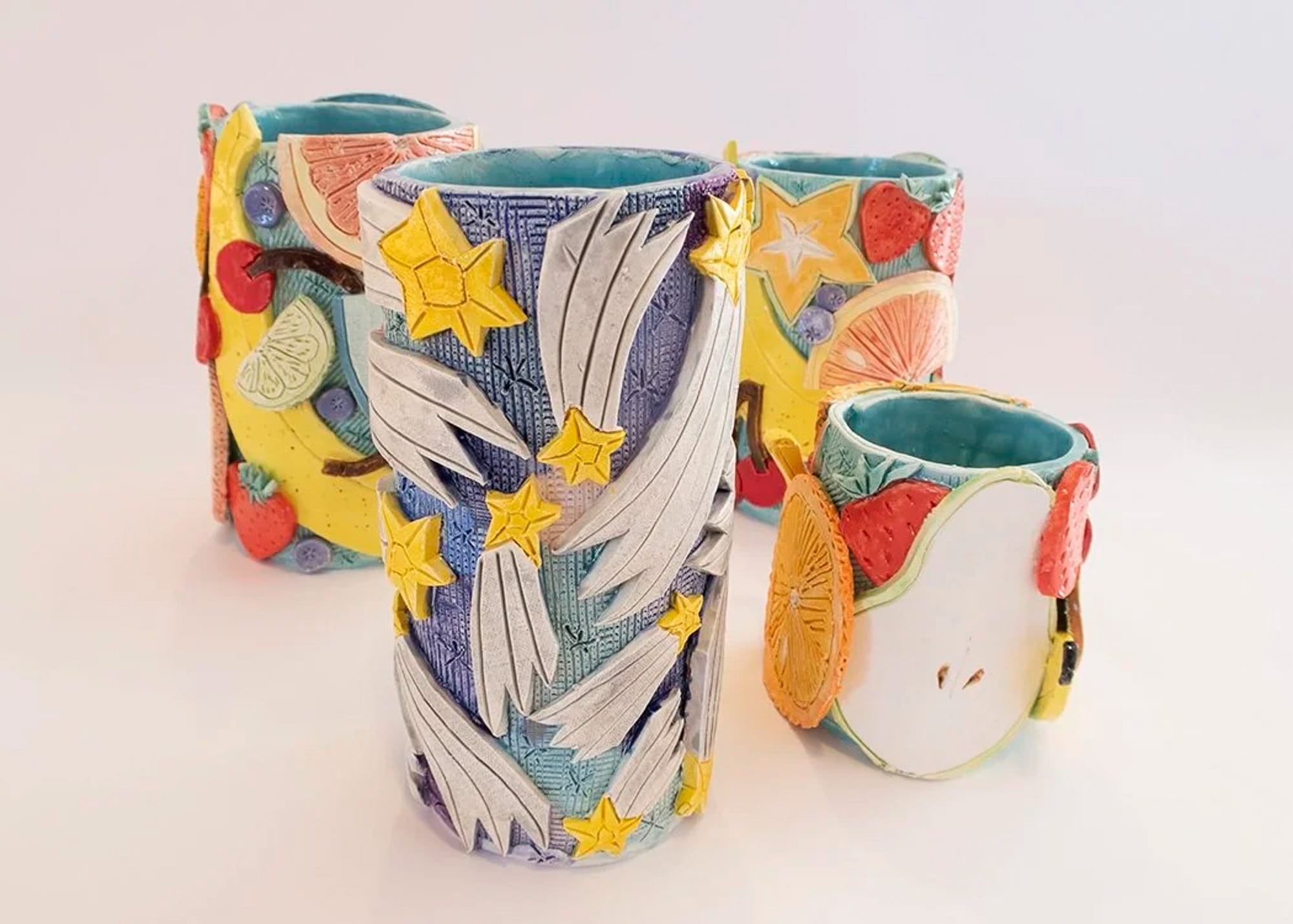
Cohen’s feminist approach is mirrored in Madeline Donahue’s ceramics, which explore the pleasures and challenges of motherhood. If that sounds like a safe subject, you haven’t spent much time in the contemporary art world. In this context, as she rightly says, it’s as “punk rock” a topic as could be imagined, a rebellion against the self-denying, self-obsessed norms of a culture that makes virtually no space for parenting. Donahue, like Hager and Cohen, is deeply involved in painting, and her ceramics have a flattish, graphic orientation that makes them perfect vehicles for storytelling. For several years now she has traced her own experience of maternity in a series of deeply touching scenes – pregnancy tests, swell-bellied selfies, parturition and all. Occasionally she gives her ceramics faux-woolly sweaters, as if they were children to be kept warm. In other cases, more obliquely, she simply festoons the pieces with fecund fruit and shooting stars, fleeting emblems of hope.
At first, Eve Biddle may seem to depart from her co-exhibitors’ extroverted exuberance. Her iconography is hermetic – serpents, pods, relics, bones – and her palette tends toward the saturnine. (In these respects, she somewhat takes after her mother, the prodigious public artist and sculptor Mary Ann Unger.) Initial appearances may be deceiving, however. As a co-executive director of Wassaic Project, no one is more dedicated to its generative and affirmative culture; Biddle’s statement on the residency website ends: “Seriously. You will totally make new friends.” That spirit also animates her work, which may be dark in palette and aspect, but positively pulses with life. Her sculptures, like Wassaic itself, bear the convulsive imprints of her shaping hands, and as a consequence they seem no less pregnant with possibility than Donahue’s, appearing variously ready to burst open, or multiply, or slither off the wall. It’s worth remembering that the snake is an ancient symbol of life of eternity, most unusual, among living things, for being able to arrange itself into a circle.
Which brings us, more or less, to where we started. It may seem a little grand to associate a little-residency-program-that-could to our most ancient and profound instincts as a species. But that’s the thing about essential needs: they never do go away, and it is no exaggeration to say that Wassaic Project exists in order to meet them. In this presentation at NADA by four genuinely wonderful artists, we can take pleasure not only in the connections they have made to one another, but also in the idea of connectedness itself. Across space and time, through countless cycles of birth and death, it’s pottery and campfires all the way back – to the beginning of recorded time, and beyond.

Related Events
Wassaic Project at NADA Ceramics 2026
Cost
Where
The Locker Room
253 Church St
New York, NY
When
Opening
Friday, March 6, 2026
4–8 PM
Hours
Saturday, March 7, 2026
12–8 PM
Sunday, March 8, 2026
12–6 PM
Who
We're proud to be participating in NADA Ceramics 2026, showcasing diverse ceramic art and design work from Eve Biddle (Wassaic Project Co-Executive Director), Grace Hager (Wassaic Project Residency and Exhibition Artist Alumna), Lauren Cohen (Wassaic Project Exhibition Artist Alumna), and Madeline Donahue (Wassaic Project Residency and Exhibition Artist Alumna). Curator, author, and historian Glenn Adamson will be writing a short essay to accompany the presentation.
Will Hutnick, Wassaic Project’s Director of Artistic Programming, states, “Wassaic Project is thrilled to be bringing these four women artists together for the first time. They are all working at the intersection of media and pushing the boundaries of what ceramics can be today.”
About the Artists
Eve Biddle is an artist, culture maker, and collaborator. Her work lies at the intersection of making objects, making connections between people, curating, building projects and institutions, helping to bring other artists’ art into the world, and making and facilitating public art. She’s a founding co-director of the Wassaic Project, home to a year-round artist residency program, art exhibitions, music festivals, and art education programs for kids, teens, and adults. Recent exhibitions include The Williams College Museum of Art in Williamstown, MA, Davidson Gallery and Sargent’s Daughters in New York City, The Buffalo Institute for Contemporary Art in Buffalo, NY, The Museum of Art and Design, New York City and Geary Gallery, Millerton, NY. Biddle has an upcoming solo exhibition at the Portland Museum of Art in Maine in 2026.
Grace Hager is an interdisciplinary painter and ceramic sculptor. Her work locates the natural world as a realm of possibility: a source of transformative encounters that generate awe, revealing the magical within the observable world. She received her Master of Fine Arts in 2023 and Bachelor of Fine Arts in Painting with a Minor in Art History in 2015 both from Maine College of Art & Design. Grace has exhibited throughout the United States, including at the Center for Maine Contemporary Art, Caldbeck Gallery, Institute of Contemporary Art, Portland, ME, Wassaic Project, MEPAINTSME, OVERLAP Gallery, CT State Gateway Community College, The Parsonage, and George Marshall Store Gallery, among others. She is the recipient of multiple grants and awards, including a CERF+ Get Ready Grant, a MAC Springboard Grant, a partial James Bernard Haggarty Scholarship, a grant from the Belvedere Fund, and a project grant from the Puffin Foundation. She is the recipient of a Fellowship in Painting from Vermont Studio Center and has been an artist-in-residence at Cuttyhunk Island Artist Residency, Wassaic Project, and Maine College of Art & Design, among others. She is a part of the 2025 Canopy Cohort under the mentorship of Rose Nestler. She currently lives and works in Southern Maine. Alongside her own work in the studio, Grace assists her former faculty and mentor, Gail Spaien, in her studio.
Lauren Cohen is an interdisciplinary artist working across drawing, painting, ceramics, film, and installation. Her practice develops recurring characters and constructed narrative worlds that examine psychological, relational, and cultural systems. Beginning with drawing and storytelling, Cohen generates figures that move between interior states and shared archetypes. These narratives extend into paintings and ceramic works, where emotional and symbolic structures are translated into material form. Across media, her work considers how identity, memory, desire, intimacy, and power are shaped, rehearsed, and sustained. In the exhibition space, Cohen brings these elements together through installation. Paintings, objects, and moving images are arranged as immersive environments that privilege accumulation and resonance over fixed interpretation. While rooted in introspection, the work resists direct autobiography, offering open narrative structures that invite multiple points of entry and collective reading.
Madeline Donahue lives and works in Brooklyn, NY. Her ceramic work was recently acquired by the Museum of Fine Arts, Boston. Residencies include The Wassaic Project, Byrdcliffe Artist Colony, Artshack Ceramic Residency and more recently, Interlude Artist’s Residency in Livingston, NY; a residency designed for artist families. Solo Exhibitions include “Fun House” with Praise Shadows Gallery, Boston; “Warm Up” with Artshack Brooklyn, and “Attachments” with Steven Harvey Fine Art Projects in New York. Along with Johansson Projects’ (Oakland, CA) summer group show, Community Garden, she has exhibited extensively across the US and in London. Her work is reviewed and she is interviewed in the Guardian, Hyperallergic, and Elephant Magazine, Sound + Vision Podcast, I Like Your Work Podcast, Artist Mother Podcast and more.
"All Together Now"
a short essay by Glenn Adamson
Ceramic is the original social technology. No sooner was clay formed and fired than it started serving as a focal point for gathering. That is a role it has had ever since. The typologies have varied greatly – archaic cooking vessel, wine-filled amphora, Renaissance charger, 12-person dinner service, 24-hour diner mugs – but wherever people come together, ceramics are almost always present. Partly, of course, this is because of their practicality. Pottery is relatively cheap, durable, mass producible, and easily decorated. Yet it’s arguably on the level of metaphor that it does its real cultural work. What could be more reassuring than a material that was once malleable, wet, and clammy, and is now fixed, warm, and dry? Not for nothing do we speak of “clay bodies,” around which we arrange our own.
Though it was founded only in 2008, Wassaic Project taps into these ancient energies. The vibrant residency and exhibition program, set in former agricultural buildings in Duchess County, draws musicians, writers, and visual artists working across all media. Ceramics has a special place, partly because there is a dedicated studio for the medium (a somewhat unusual provision, among residency centers), and partly because so many members of the community share a passion for clay. This presentation at NADA features Wassaic co-founder Eve Biddle, as well as Lauren Cohen, Madeline Donahue, and Grace Hager, all alumnae of the program.
A work from Hager’s series Sunset Seeking has become an unofficial emblem of the exhibition at NADA Ceramics. Entitled Starry Night, it refers to Vincent Van Gogh not just in its title but its celestial color palette and restless directional brushstrokes. It’s also, as Hager puts it, a “sort of wink at the role of temperature and heatwork required for the craft.” (This might just be the oldest joke in ceramics, given that the Jōmon people of ancient Japan made “flame-topped” pots about 5,000 years ago.) Most importantly, the sculpture evokes the experience of nighttime communion, of huddling together for warmth in the darkness. Much of Hager’s work, whether in painting or ceramic, focuses on such moments of magical connection – a metaphorical interest that the other artists in this presentation also share. They have forged strong connection to one another through the community at Wassaic Project, at a time when the very idea of community has been subjected to unprecedented stress, both due to the Covid pandemic and the reactionary, divisive politics that were accelerated by that period of mass isolation.
In response to this unfolding tragedy of the commons, this quartet of artists offer both alert critique and “full-on play” (as Biddle puts it), a combination of activism and absurdism. Lauren Cohen exemplifies this approach. Her wide-ranging practice encompasses not just ceramic sculpture but also painting, graphic novels, and performance art. What unites this diversity of explorations is an expansively first-person approach, often involving invented characters that she adopts as alter egos. Her Figurehead Teapot (2025), for example, features a female figure, legible as a self-portrait, swathed in quilted fabric with shining mackerel flanking her sides – an ornamental and often sexualized maritime trope, wittily reclaimed as an emblem of self-navigation. At NADA, she subtly satirizes the hypocrisy of the art world itself, which she experienced firsthand as a “gallerina” (that terrible word), albeit in the intentional mode of a quasi-anthropological participant observer. Her upended oysters and charcuterie platter are inspired by experiences of art openings, in which these delicacies are distributed to the wealthy, for free, by people who are paid next to nothing. A face nestles in each shell, pearls choking its mouth; these are, as Cohen notes, “objects that stare back.”
Cohen’s feminist approach is mirrored in Madeline Donahue’s ceramics, which explore the pleasures and challenges of motherhood. If that sounds like a safe subject, you haven’t spent much time in the contemporary art world. In this context, as she rightly says, it’s as “punk rock” a topic as could be imagined, a rebellion against the self-denying, self-obsessed norms of a culture that makes virtually no space for parenting. Donahue, like Hager and Cohen, is deeply involved in painting, and her ceramics have a flattish, graphic orientation that makes them perfect vehicles for storytelling. For several years now she has traced her own experience of maternity in a series of deeply touching scenes – pregnancy tests, swell-bellied selfies, parturition and all. Occasionally she gives her ceramics faux-woolly sweaters, as if they were children to be kept warm. In other cases, more obliquely, she simply festoons the pieces with fecund fruit and shooting stars, fleeting emblems of hope.
At first, Eve Biddle may seem to depart from her co-exhibitors’ extroverted exuberance. Her iconography is hermetic – serpents, pods, relics, bones – and her palette tends toward the saturnine. (In these respects, she somewhat takes after her mother, the prodigious public artist and sculptor Mary Ann Unger.) Initial appearances may be deceiving, however. As a co-executive director of Wassaic Project, no one is more dedicated to its generative and affirmative culture; Biddle’s statement on the residency website ends: “Seriously. You will totally make new friends.” That spirit also animates her work, which may be dark in palette and aspect, but positively pulses with life. Her sculptures, like Wassaic itself, bear the convulsive imprints of her shaping hands, and as a consequence they seem no less pregnant with possibility than Donahue’s, appearing variously ready to burst open, or multiply, or slither off the wall. It’s worth remembering that the snake is an ancient symbol of life of eternity, most unusual, among living things, for being able to arrange itself into a circle.
Which brings us, more or less, to where we started. It may seem a little grand to associate a little-residency-program-that-could to our most ancient and profound instincts as a species. But that’s the thing about essential needs: they never do go away, and it is no exaggeration to say that Wassaic Project exists in order to meet them. In this presentation at NADA by four genuinely wonderful artists, we can take pleasure not only in the connections they have made to one another, but also in the idea of connectedness itself. Across space and time, through countless cycles of birth and death, it’s pottery and campfires all the way back – to the beginning of recorded time, and beyond.
Sponsorship Levels
Our Sponsors
Photos