
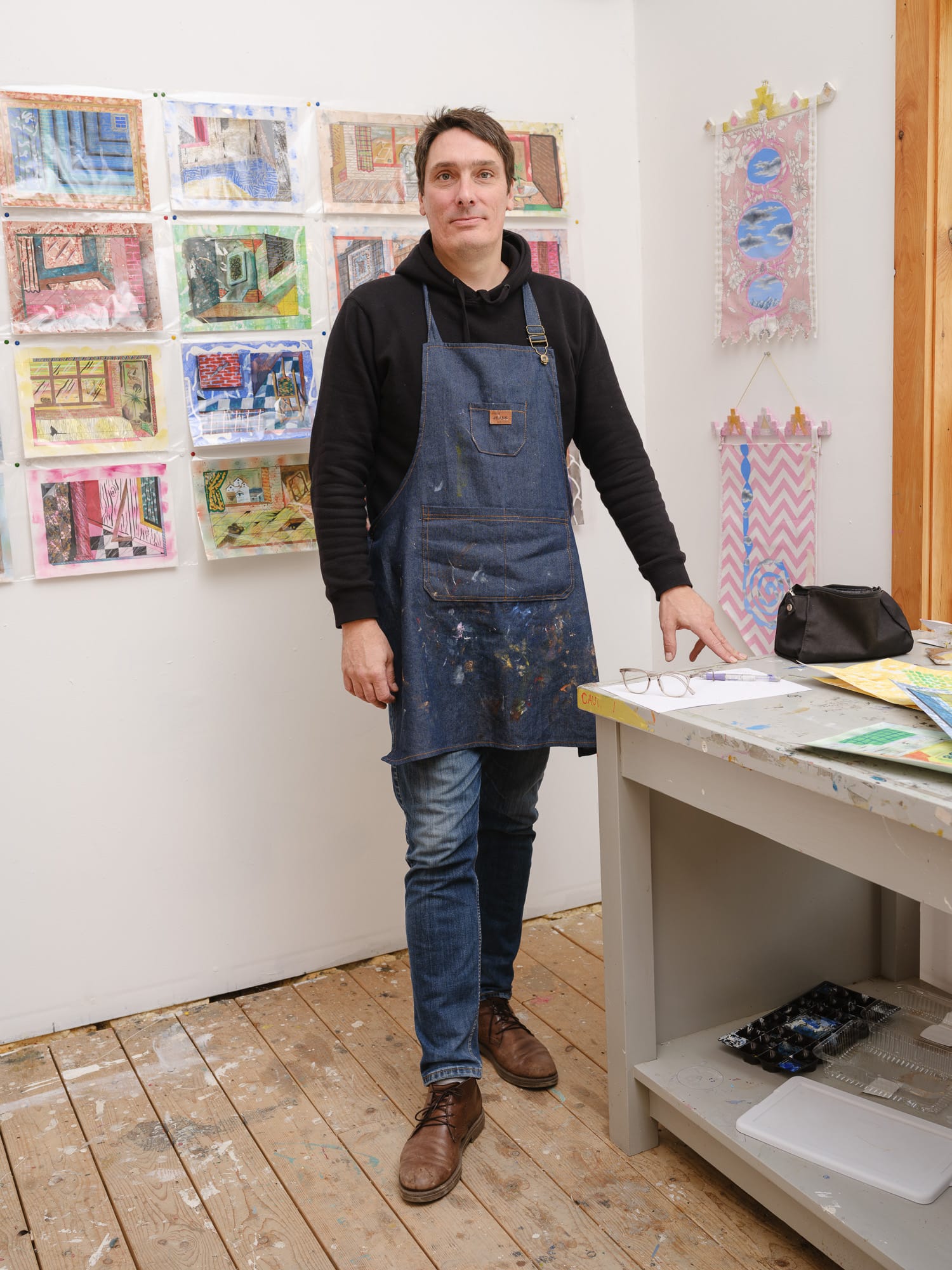
with Lucy Commoner, December 2025
LC: You were awarded a family artist-in-residence in 2025 and created the watercolor series in this exhibition while you were in the residency. What was your experience in the family residency, and what led to the production of this series?
GP: It is difficult to avoid enthusiasm and not fall into clichés when describing our stay at the Wassaic Project residence. It was a break from our family life in Santiago, Chile, where we live. A break filled with very memorable experiences that I am sure we will continue to remember. While for my wife, Mary Ann, and our daughters, Emilia and Victoria, the stay in Wassaic was a curious break and a peaceful winter retreat, for me it was a period of intense concentration on my work. We were all impressed by the landscape, which contrasted with the warmth of the people we met there: hosts, residents, townspeople.
We had left behind daily temperatures of around 30 degrees Celsius (86 F) and landed in a cold we had never experienced before. Seeing snow everywhere, walking on it, making snowmen, following the footprints of deer, bears, and raccoons... It was all too vivid and exciting for my “gang” and me. We made hot chocolate almost every day, and whenever we went out, whether to buy food (the precious bread from Vitsky Bakery) or just to go for a walk, a warm, cozy house awaited us, which we made our own from the very first minute. We honestly felt like we were in a Christmas movie (in Santiago, the Christmas season is dry, bright, and very hot).
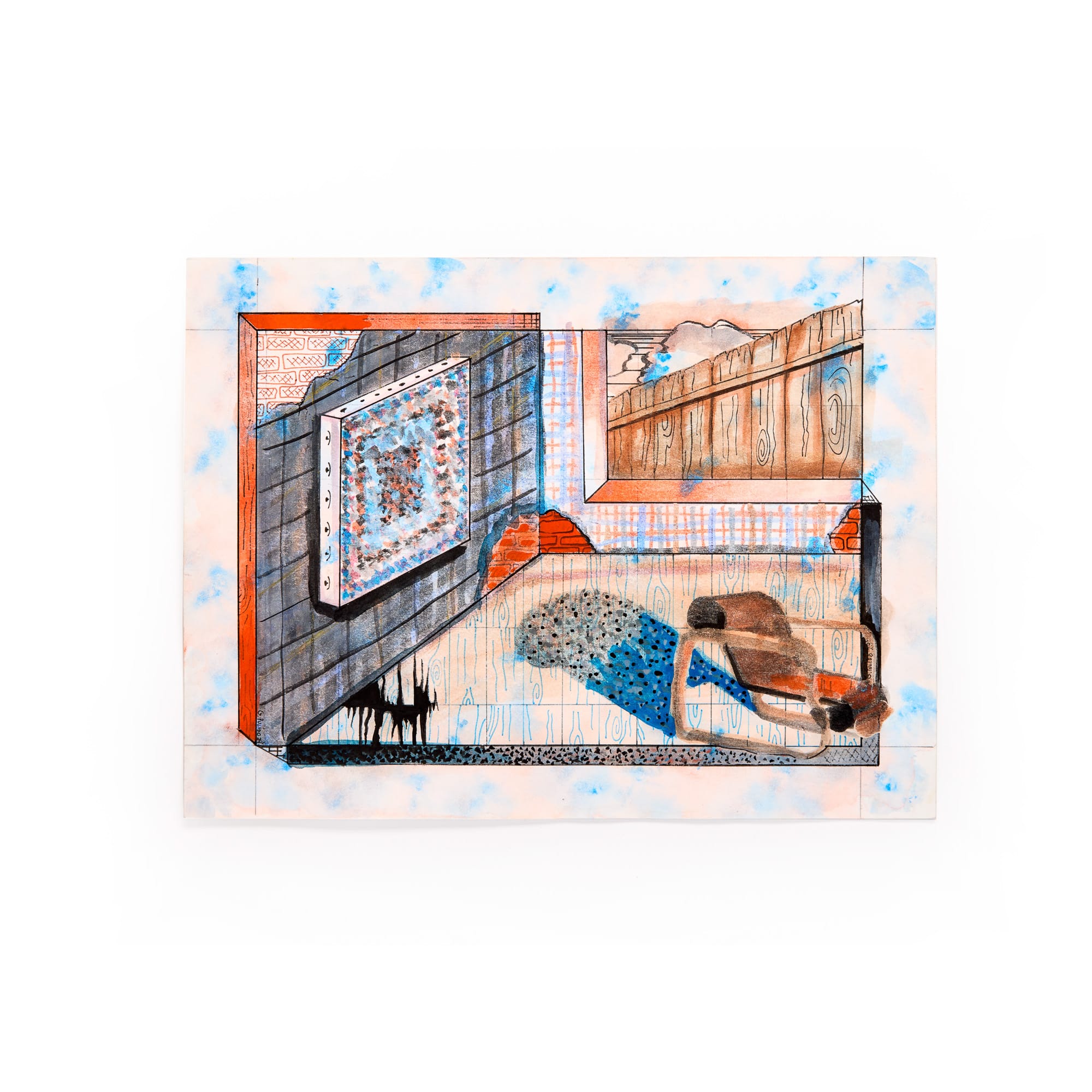
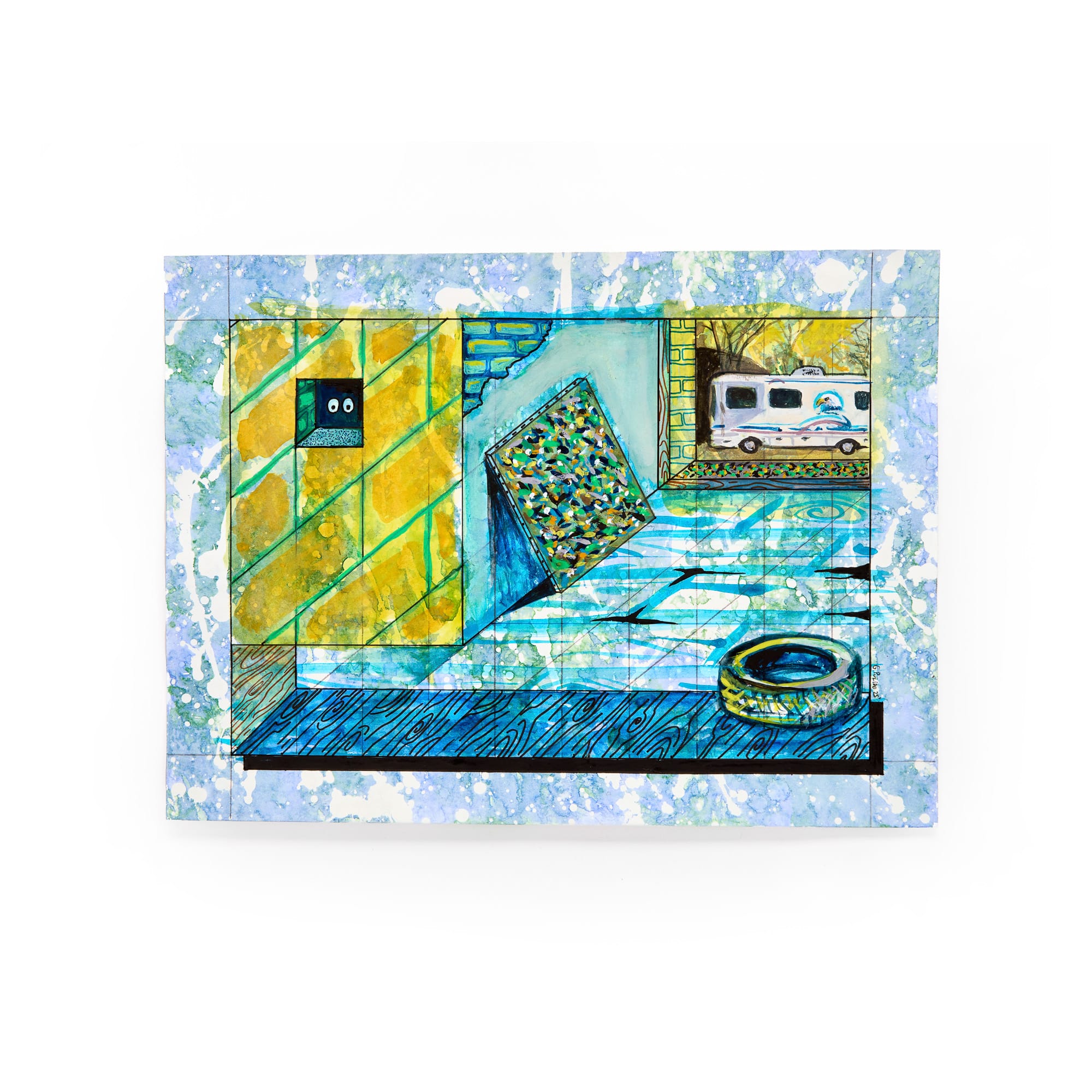
The days passed in Wassaic, and I incorporated into my images some of the things I saw on those walks or on the way from the HVA House to the studio, such as a motorhome parked close to the mill. Without meaning to, I became a collector. My collecting was due to the series I had decided to continue at the Wassaic Project: Set, a small-format painting (and drawings) on paper that I had begun in 2022.
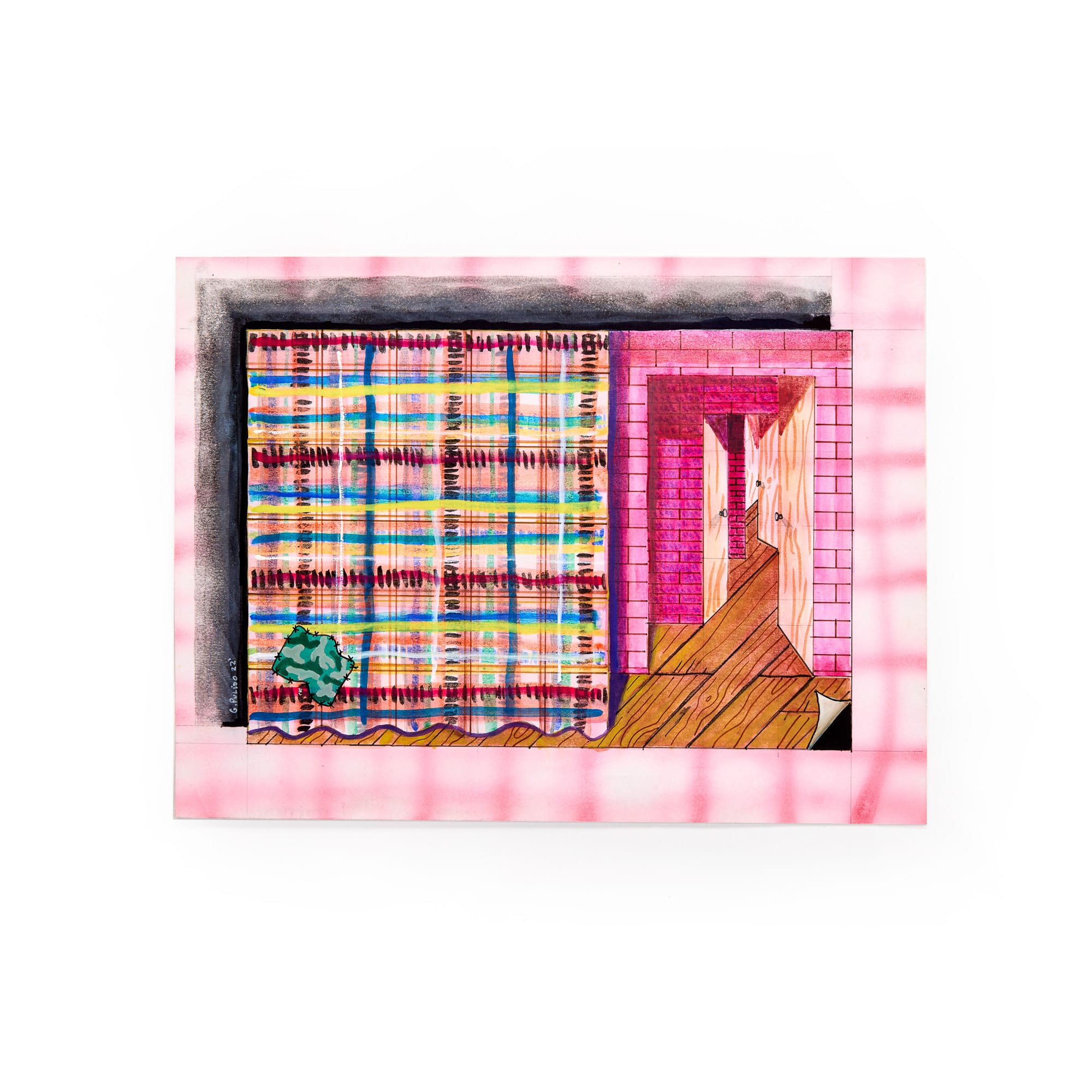
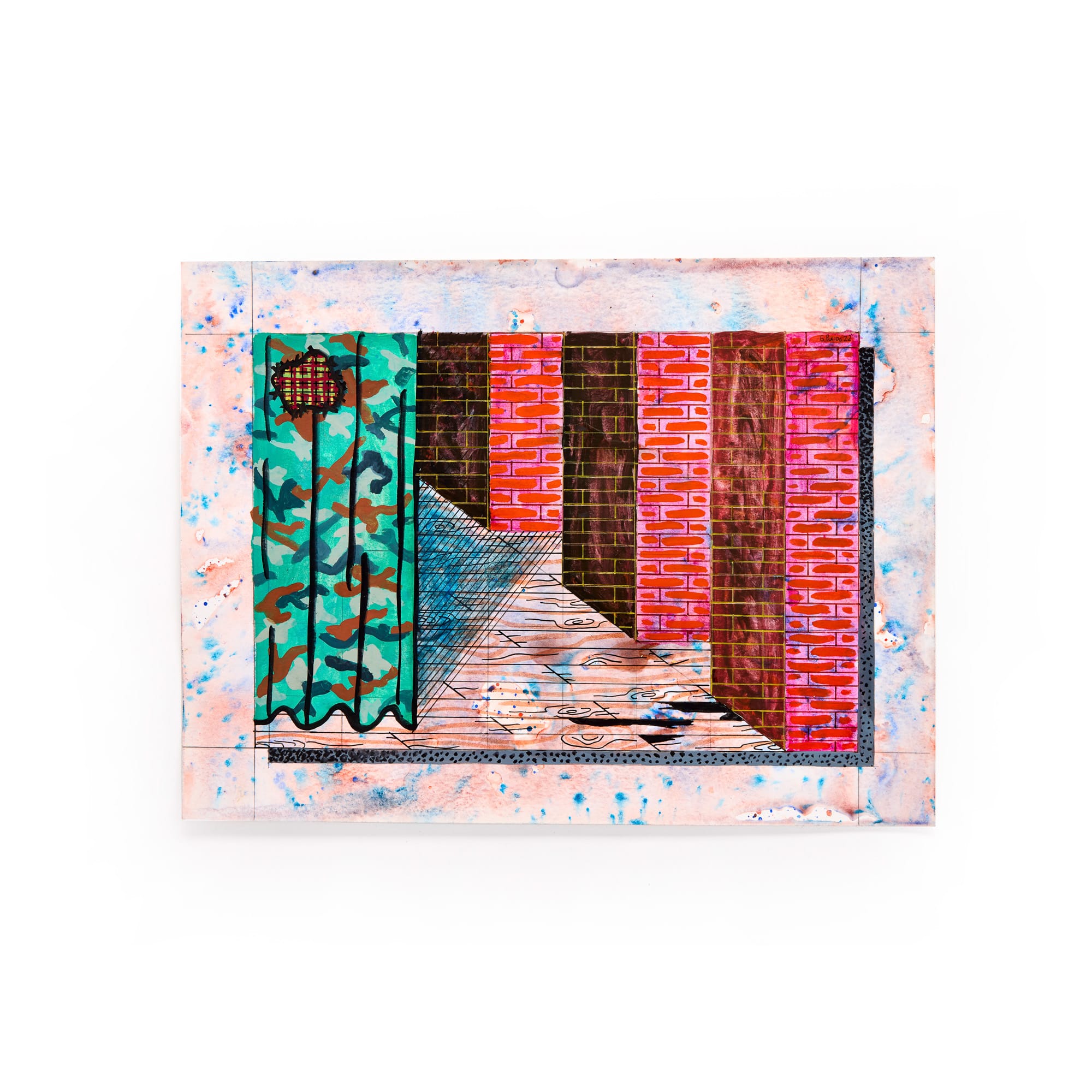
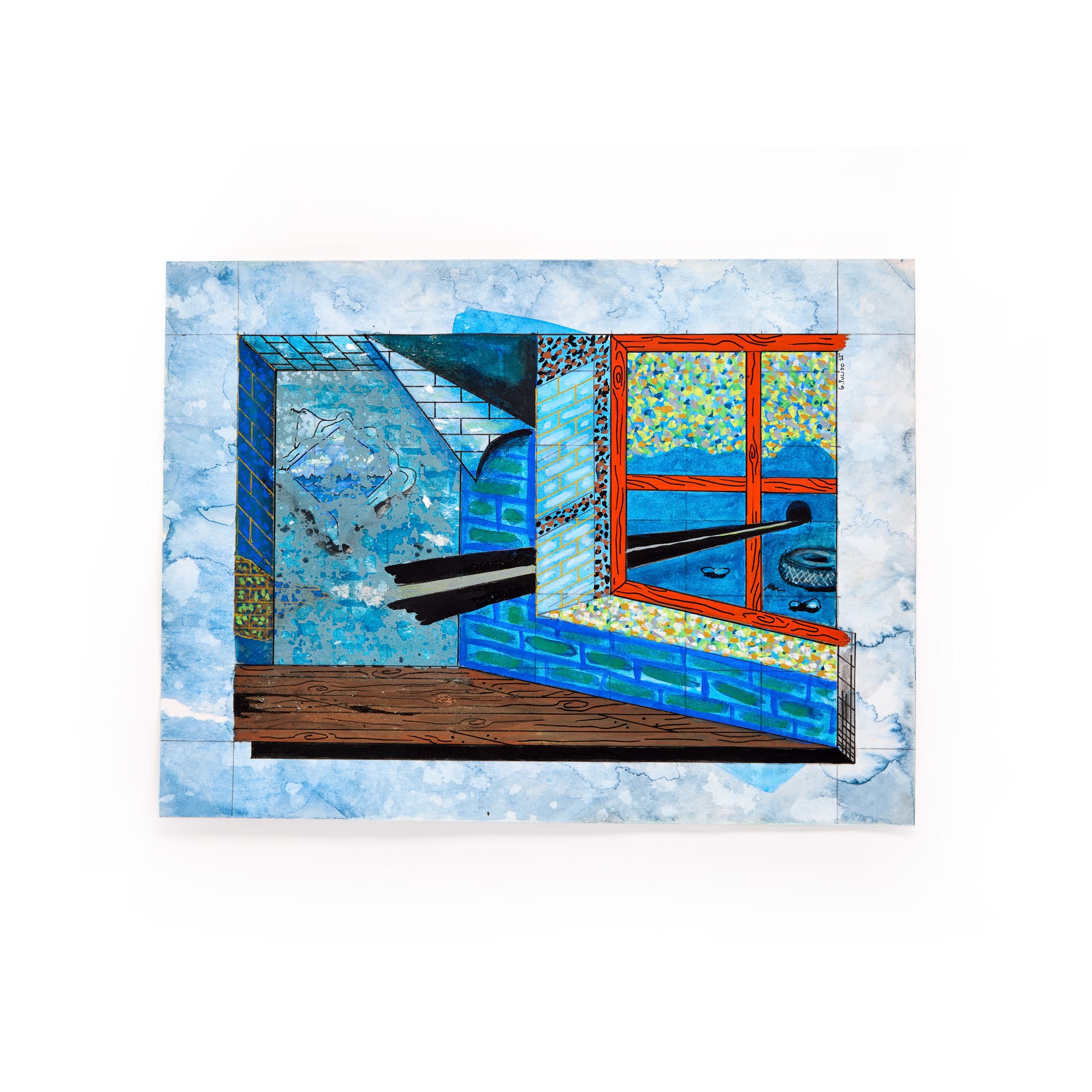
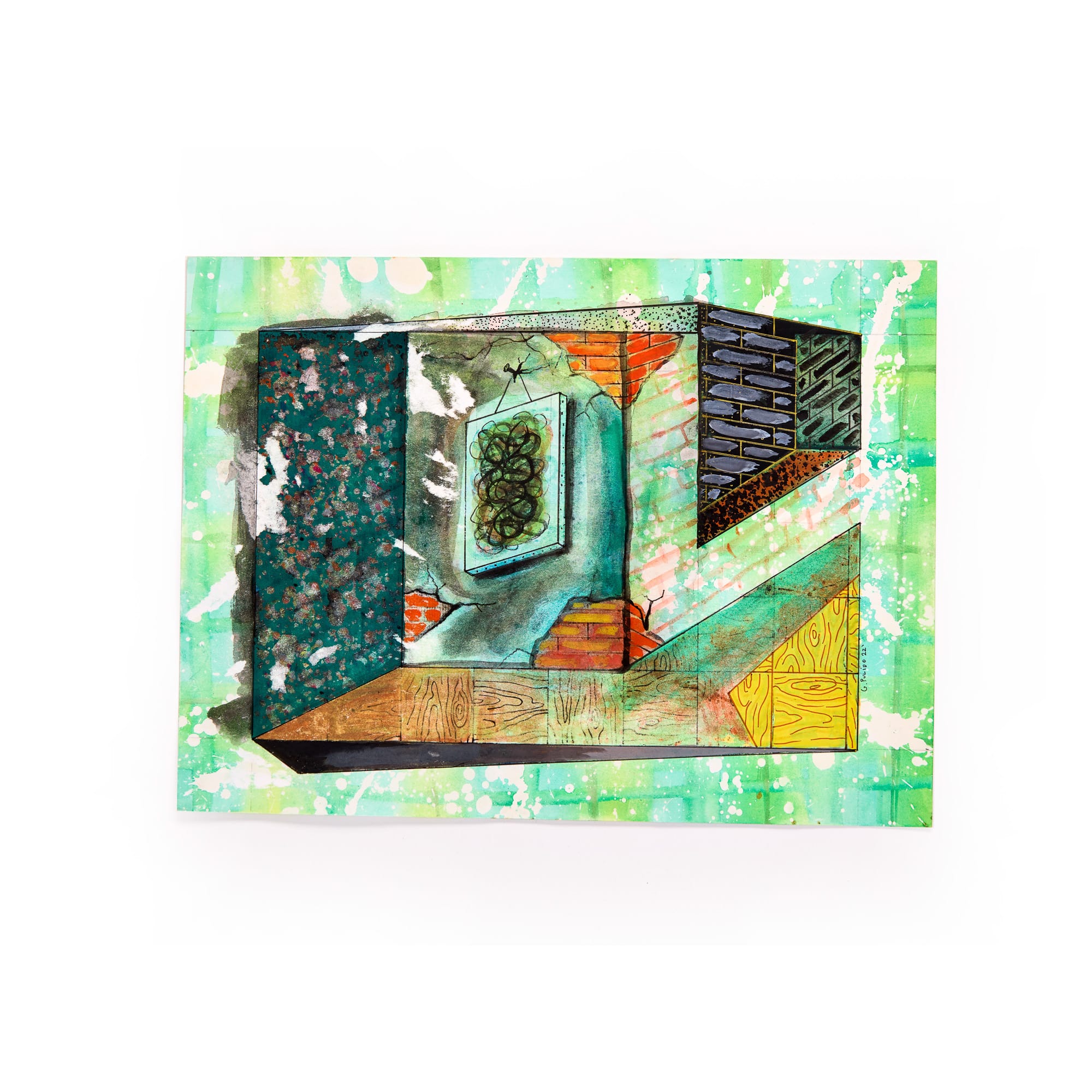
It is a set of rules that I have imposed on myself since I started Set. What has varied, however, is what I put inside the paper: what colors, spots, perspectives, coatings, and what specific scenery and props I use. In this regard, I have allowed myself a great deal of freedom and, for this reason, I thought it perfectly appropriate to include fragments of my experience, so to speak, in Wassaic. In a way, Set shows the backdrop that makes up my daily life and something of my nights (dreams, nightmares), a continuum where the artistic and the domestic become confused.
LC: While exhibiting your artworks internationally, you live and work in Chile, where you are a university professor of art and a working artist in a wide array of materials and formats. In what ways are the culture and historiography of Chile expressed in your work?
GP: Santiago is far from being an international art hub. My country is literally distant from the major political and economic powers. Located in the southern hemisphere and perpetually developing, Chile offers few opportunities to the artistic community, yet it has extraordinary creators. So, creating art with what you have at hand, even if it's almost nothing, is imperative in a place like my country.
There aren't many of us who can devote ourselves to art (and the national population isn't very large, at just over 19 million), fully embodying the saying “small town, big problems”. The need to develop simultaneously abroad, I believe, becomes almost inevitable in the early and middle stages of one's career. Such is my case; balancing that with teaching, for example, is no easy task.
I am anchored to Chile not only academically. Being a professor, in any case, has been and continues to be decisive for my work, to put it to the test, to demand of it what I demand of my students, undoubtedly learning from them and from the general challenge of teaching. It may be an overstatement, but I feel that everything I have done artistically is inseparable from my understandings, intuitions, discomforts, torments, and questions about being Chilean.
Chile's colonial and pre-Hispanic past and the Latin American visual culture linked to both eras have nourished my sculptures, paintings, print work, and other pieces. From José Gil de Castro's “colonial painting” to the Condorito comic strip, to give just two examples, they have shaped me as an artist.
The case of Condorito, in particular, has had a certain influence on Set. The irreverence of the graphics in that magazine and character, created in 1949 by Chilean René Ríos (alias Pepo), its constant allusion to scarcity, and its representation of a precarious city still under construction, are things that I have taken and poured into Set. These are things that I believe have also unconsciously crept into this and other works, given the impact that publication had on my childhood, as it has had on several Latin American generations.


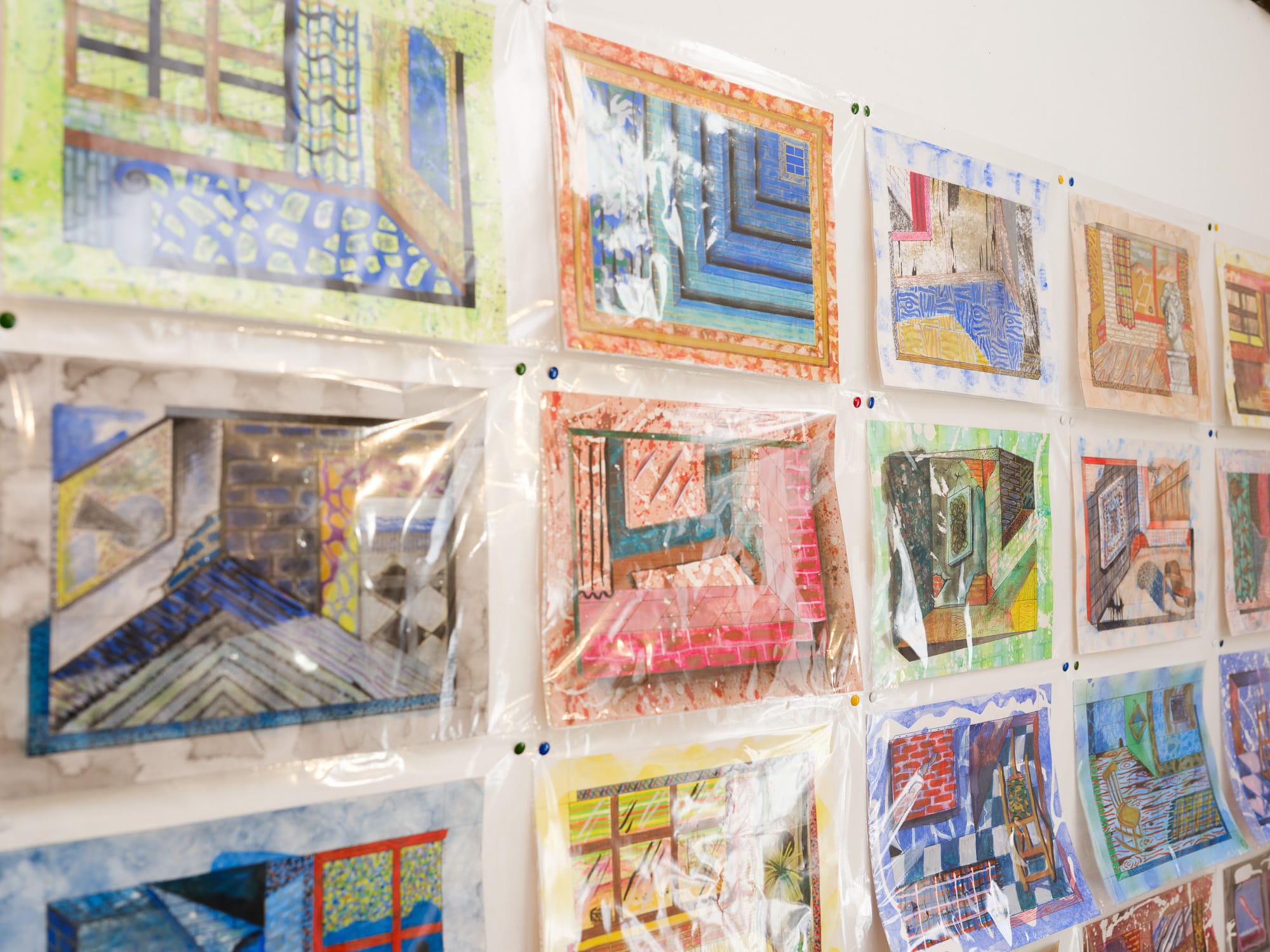
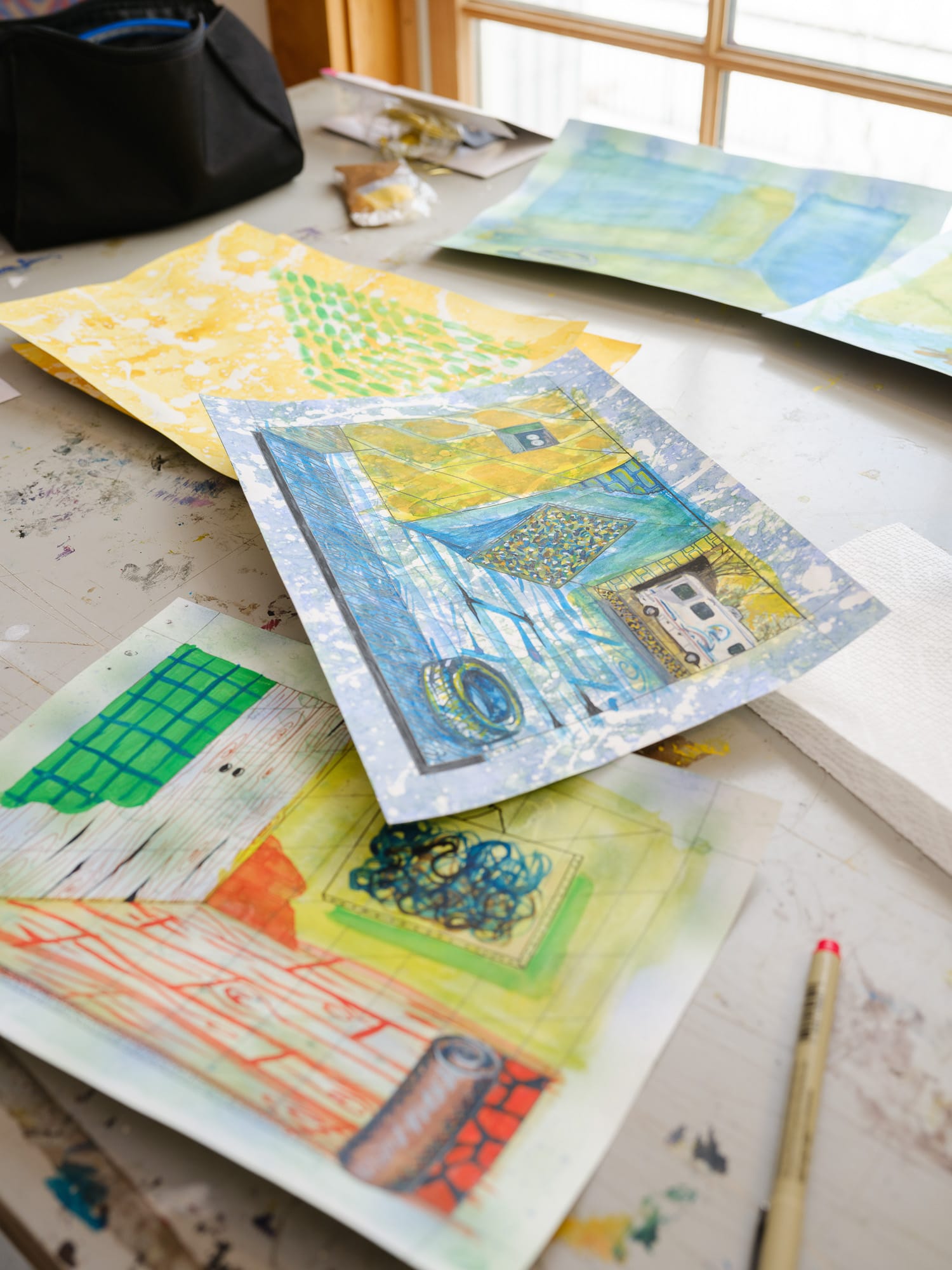
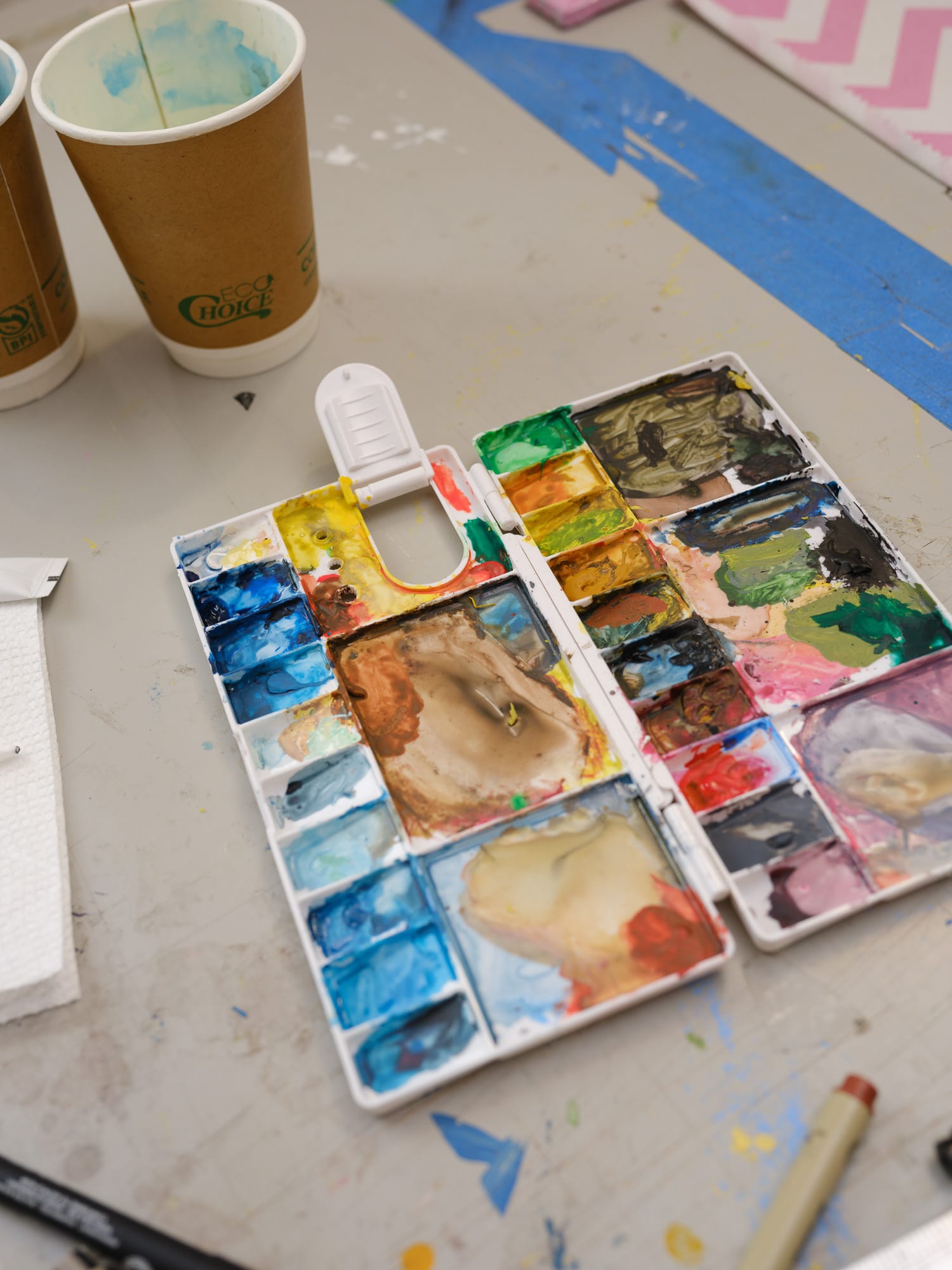

LC: The full span of your artwork includes both two-dimensional and three-dimensional forms. There are strong architectural and design sensibilities that run through your work. Your drawings, like the series in this exhibition, often evoke the architecture of an interior space, and many of your sculptures feel like architectural models for larger structures. What role do architecture and design play in your art practice?
GP: I consider myself as much a painter as a sculptor. It depends on the day, although for periods (years) I have devoted myself to one craft and then the other. While I tend to pay close attention to the surface of my sculptures, in my painting, the three-dimensional aspect has become decisive, especially in my latest images. Sometimes I have created intermediate works: simultaneously pictorial and sculptural.
Craftsmanship has been a constant throughout my working life. By this, I also mean that I make a lot of decisions along the way. In this sense, design does not play a major role, as I rarely make preliminary sketches. What does matter to me is composition. I am referring to the need to put together a whole that feels like one and the challenge of balancing the different. The feeling of fit, coherence, and unity, especially when working with very different things, as in my case, is not easy to achieve. The greater the heterogeneity between the components of an image, the greater the difficulty in generating dependence between them.
As for architecture, I am forced to admit that I am a frustrated architect. Nowadays, I find it hard to imagine myself as an architect, but there is a family influence. On my mother's side, there are several people linked to architecture. One name stands out: Gustavo Mönckeberg Bravo (1884-1944). There are still some buildings in Santiago designed by him, my great-grandfather. But for me, it was his son Hernán, my grandfather, who drew my attention to architecture in an emotional way, from the outset, because he was also an architect. And he unwittingly introduced me to watercolor painting, beyond what one learns as a schoolchild.
I had flashbacks of my grandfather painting his watercolors when I painted Set. In the past, architectural plans were often painted with India ink and watercolor, both of which were commonly used in architectural work. I imagine that's why my grandfather painted with watercolors in his spare time: landscapes, portraits, etc., usually based on photographs. He was an amateur painter. And I remember his impeccable work table in his apartment, full of graphite pencils, markers, and different round brushes grouped in different containers, several rulers organized on one side, and paper almost always in the center of that intimidating architect's board. It was an altar, untouchable for his grandchildren.
Set is somewhat the result of that board. In fact, I work on the series with very similar tools, all in a more modest and disorderly version. The spaces I represent in each image are indeed architectural. But instead of facades, I design more or less absurd interiors, with twisted and/or contradictory perspectives, for example. And I am possibly more interested in the everyday use of architecture, without wanting to know about its users, excluding them from my scenes, in fact.
LC: There is a wonderful exuberant sense of materiality combined with an additive collaging of patterns in your work. Can you talk a bit about your process in creating the series of watercolors in this exhibition?
GP: Set depicts a suffocating, flat space, sometimes precarious and absurd. It refers to a movie set and, less explicitly, to a game.
The game, as in some sport, is the general method with which I paint: I propose to play with geometry and the overflow of the stain, with the plane and the “illusion” and, by the way, with improvisation and a certain systematization. According to these parameters, I allow myself to quote the history of art (cubism, surrealism, and/or abstraction) but also the world of comics (Condorito).
My set's design features a set of materials, such as stone, wood, fabric, and bricks. I never lose sight of the fact that I am representing things. I have forced myself to imitate these surfaces because I have been doing so since 2011 and because, obviously, my focus in them has not yet waned. It is quite likely that my interest in simulating materials comes from architectural painting, which could be considered a B-story of painting. The sometimes rough marbling of pillars and altarpieces in so many adobe churches in Chile or those built of wood, such as those in Chiloé island, have triggered much of that interest in me. In turn, the decorated cloaks of saints and virgins present in those same churches have lingered in my mind to this day.
I must acknowledge here the constant influence of my wife and her profession: she is a restorer. Thanks to Mary Ann, I have seen 17th-century polychrome wood sculptures up close, for example. So, if Set has a baroque mood, I think it is not only because of the number of elements that compose it, but also because of how much the so-called American baroque unsettles me.
LC: The six pieces in this exhibition are a subset of a larger series entitled “Set” that you completed during your residency. In each of the pieces in this series, you employ watercolor, gouache, marker, and graphite on paper. Each of the identically sized drawings is inset within a patterned background that is partially visible beneath the central drawing and serves as a framing device. The drawings themselves appear to be almost stage sets of interiors for some mysterious story. What appeals to you about working with a series where multiple factors connect the works together?
GP: Armed with a graphite pencil, ink marker, watercolor, and gouache, I have worked on Set on papers of the same size, laid out horizontally. I put together (and continue to put together; the series is still open) a preliminary and simple grid capable of evoking and structuring the design of a room somewhere between a house and a studio. I use the propelling pencil to draw that grid, sometimes before painting, and sometimes after a first wash: straight lines, it varies, although it preserves the same lateral margins.
Although I make the rules flexible when working on Set, I find them essential when creating that series or any other work. I truly believe that creative freedom does not depend so much on doing anything you want, but rather on consciously deciding what limits to follow, what game to invent, and what rules that game—hopefully a new one—will have. In my experience, these things are largely defined by the process itself as the work takes shape. At least, that's what I try to do: follow the will of the work.
In any case, I think humor is essential, starting with the fact that it can dismantle any system. So, when you become very rigid or serious (while creating a work), taking things with humor can be urgent. In a more concrete sense, I love seeing several finished images from Set together because they look like vignettes that make up a sequence. I don't have a conventional pre-established script. I prefer to look at several of my watercolors from the distance of a viewer, who can imagine very different stories. They may suggest the adventures, both stormy and humorous, of some prototypical artist or some strange inhabitant of often absurd interiors. Anyway, when I see them together, I can't help but smile and think of Condorito again.
Gerardo Pulido (b. 1975) lives and works in Santiago, Chile. He is a painter and sculptor with more than twenty-five years of experience. He has exhibited his work in Australia, the United States, France, England, and various Latin American cities. He has held residencies in Argentina (RIAA, 2008), the United States (Wassaic Project, 2025), and Puerto Rico (MCEH, 2022–2021). He occasionally publishes texts on art, with two books of essays (2017, 2022). Additionally, he was a co-creator and member of Taller BLOC (2009–2022, Chile).
Pulido holds a DEA in Art Education (University of Seville, Spain, 2005), a postgraduate degree in art (UC, Chile, 2002 and 1999), and is currently an Associate Professor at the UC School of Art.

This Must Be The Place
2025 Summer Residency
